
Article
A multiplayer space strategy game you play over months
In this post
Old Light is a free multiplayer space strategy game that runs in your browser. You start with one star system in a galaxy shared with other players and grow it into an empire over weeks and months, in short visits, while the galaxy carries on between them.
I built it for a particular kind of player. Maybe you lost whole winters to OGame or Travian years ago and still miss having a long game running in the background. Maybe you love building an empire in Stellaris and can't remember your last evening long enough to start one. If you have been describing the game you want and keep finding things that are nearly it, this post goes through what you are probably asking for and how Old Light handles each part.
A strategy game that lasts for months#
Old Light's main galaxy has no rounds and no end date. It is one continuous world, so the empire you found today is still on the map months from now for as long as you hold it.
That gives early decisions a long reach. The territory you stake out in your first weeks is still the ground you are defending months later. Further out, holding 60% of a named sector earns you its bonus, and sectors are grouped into regions with their own leaderboards.
Build an empire from one star system#
You begin with a single star system that is already yours, and your first sessions all happen inside it. Your core structures start at level 1, and every upgrade you pick goes into a build queue that runs in real time, even with the tab closed.
The early game is about keeping an economy in balance. Almost every upgrade costs both palladium and iridium, so letting one extractor run ahead only makes the other your bottleneck. Your extractors keep filling your Resource Depot overnight, and a small depot means income that stalls before morning. Push your load past what your Reactor supplies and the whole system slows down until you catch up on energy.
Later a Shipyard opens up the map. You can spar with the nearest NPC, then send a vanguard to colonise a dormant star and become a two-system empire. The beginner's guide walks through that opening in order.
A game that keeps going while you are offline#
Your empire runs whether the tab is open or closed. Resources accrue up to your storage cap and fleets keep flying, because the server keeps the galaxy going by itself.
Everyone else keeps moving too, which is the fun of it. The first thing you do on a return visit is read your reports and look at what changed on the map. A battle resolves the moment a fleet lands, with or without either player watching, so a raid you sent at breakfast may be waiting for you as a report after work.
For a holiday or a busy stretch, vacation mode puts your empire on hold for up to three weeks.
Deep strategy in a few minutes at a time#
Old Light is built to be checked twice a day, around twenty minutes in total and often less in the early days. Builds take minutes to hours in real time, so you queue what you want and close the tab.
A morning visit might be reading the night's reports and sending a fleet that will land by the afternoon. There is no stamina meter and no login streak to protect, and no event you have to be online for. If you want to climb the leaderboard, checking in more often helps, as it does in any game of this kind. I wrote more about that rhythm in a strategy game you only have to check twice a day.
Real rivals on a map you can read#
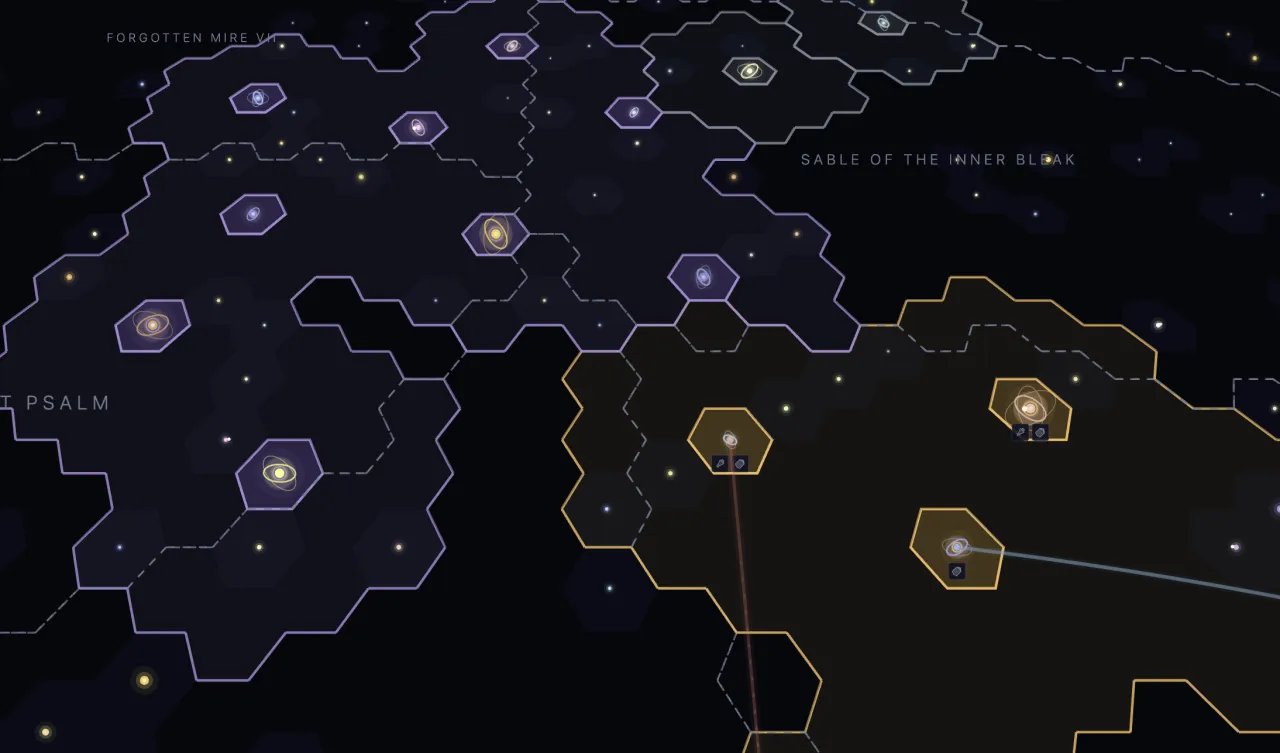
The galaxy is shared by every player at once, and computer-controlled empires settle it alongside them. You can see the whole map from day one: every star and every empire's borders. Human empires fly their own banner colours and NPC empires show up in grey. The NPCs play by the same rules you do and spawn near every new player, so you have neighbours from the start.
What a rival has built stays hidden until you send a probe to find out. A system's score hints at how developed it is but says nothing about the fleet in orbit, so a scouting run before a strike can save you a fleet.
You can message other players and, from there, strike a deal to swap systems and credits, or sign a 14-day peace treaty that neither side can leave alone. If you would rather have someone you know out there, an invite link brings a friend into the same galaxy, and the game does its best to place them near you, though it can't guarantee it.
Space battles and conquest without the clicking#
You win fights in Old Light by deciding what to send and where. You choose the ships and the target, and when your fleet lands the battle resolves in one or two rounds using rules you can read for yourself.
Four ship classes cover the jobs: probes scout, marauders attack, sentinels defend and vanguards capture. A mixed fleet travels at the speed of its slowest ship, so what you send also decides when it arrives.
Taking a rival's star is a siege. A vanguard rides in with a combat escort and, if the escort does its job, drains 20 to 35 points of the star's loyalty, which caps at 100 and recovers by 2 every hour. A star at full loyalty takes at least three waves to capture, and each wave leaves a report telling the defender how close they came, so the other side gets a chance to answer.
An empire you can shape your own way#
There is more than one way to grow in Old Light. You can go tall and push a few systems to high levels, or go wide and claim more systems at modest ones, and both raise your score.
Once you hold two systems you choose a government. Admiralty is built for war on other players, Consortium for growing by taking NPC stars and Protectorate for holding what you have. Every bonus comes with a drawback, so the choice costs you something, and each government then offers six policies of which you can adopt three.
Trade is a way to play too. A Trade Hub earns the credits that pay your fleet upkeep and fields the cargo ships you use for trading on the offer board. NPCs post offers there as well, so the board is rarely empty.
A fair fight that money can't change#
Nothing for sale in Old Light makes your empire stronger. Premium buys convenience and cosmetics, like longer queues and extra banner options. It gives no resources and no better ships, and it cannot shorten a build. A player who has never spent anything is held to exactly the same rules.
New players get room to learn. A five-day shield stops anyone attacking or probing you, and practising on NPCs does not break it.
After that, morale makes a much larger empire fight at reduced strength against a much smaller one. In a galaxy with no end date, that rule is what keeps joining late worthwhile, because the largest empires would otherwise be free to pick off every newcomer around them. Past about 3:1 on score an attacker's ships fight markedly weaker, and at 10:1 the attack costs more in losses than the loot can repay. A big empire gets more out of fighting someone closer to its own size.
Nothing to install#
Old Light runs in any modern browser, on a desktop, a phone, a tablet or a Chromebook. There is no download and no app, so you can check on your empire from whichever device is in front of you.
A modern take on the browser games you remember#
Old Light is a persistent browser-based game, or PBBG, from the same family as OGame, Travian and Tribal Wars. If you played those, the rhythm will feel familiar: build timers, and neighbours whose borders creep toward yours. A star system is what a village is in Tribal Wars, and you grow by taking the systems around you until you meet someone doing the same.
The browser strategy games I grew up on were hollowed out by pay-for-power, and Old Light is my attempt at the format without it. It went live in June 2026 and is made by one developer with no publisher behind it, so the galaxy is younger and smaller than games that have run for decades. New features land regularly, most recently governments and policies and vacation mode.
If you want to look around first#
The live galaxy map shows every empire and its borders without an account, and the leaderboard shows who is ahead.
If you want to compare before you commit, free space strategy games sets Old Light beside the other browser options, games like OGame and Travian covers the classics, and games like Stellaris starts from the 4X side. For historical settings there are games like Grepolis and Ikariam. If you are still working out what you want, what makes a good browser strategy game is a useful place to start.
Common questions#
What kind of game is Old Light?#
Old Light is a free, browser-based 4X strategy game set in one persistent galaxy shared by its players. You grow a single star system into an empire over weeks and months, and the game continues while you are logged off. It belongs to the same family as OGame and Travian.
Is there a free multiplayer space strategy game with no download?#
Yes. Old Light is a free multiplayer game that runs entirely in a browser, with nothing to install. Optional Premium sells convenience and cosmetics, and nothing for sale makes an empire stronger.
Is there a 4X game I can play in short sessions?#
Yes. Old Light is designed around two check-ins a day, about twenty minutes in total. Builds and fleets run on real timers while you are away.
Is Old Light turn-based or real-time?#
Neither in the usual sense. There are no turns and nothing depends on quick reactions. Builds and fleets resolve on real timers that run from minutes to days, and you check in when it suits you.
Can I play Old Light with friends?#
Yes. A friend who starts from your invite link joins the same galaxy as you, and the game does its best to place them nearby, with no guarantee. You can message each other and turn those talks into deals.
Is Old Light like OGame or Travian?#
It comes from the same family. The economy and fleets follow the OGame and Travian model, the map works more like Tribal Wars, and nothing for sale makes an empire stronger.