
Announcement
Old Light now asks how you want to rule: governments & policies
Until this update, every empire in Old Light ran on the same rules. Two players with the same number of stars built at the same speed, paid the same upkeep and had the same odds in a fight, and the only real differences between them were where they expanded and who they attacked.
Old Light now has governments, policies and edicts. They add a decision that sits under all the others, about what kind of empire you are running, and each of them helps you in one area while costing you in another.
Three governments to choose from#
You choose a government once your empire holds two systems.
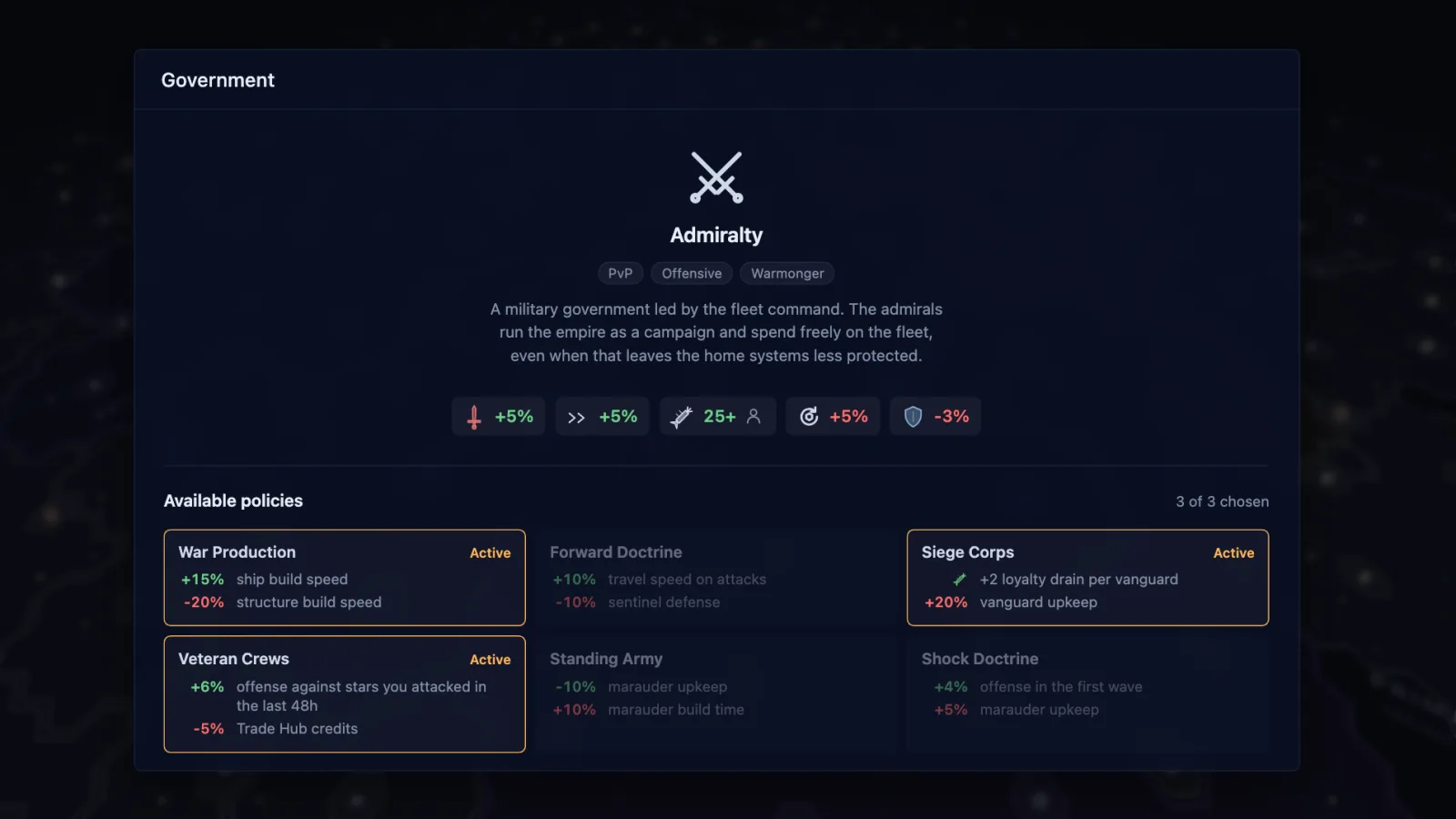
The Admiralty is built for war. Its fleets hit harder when they attack and fly 5% faster, and its vanguards drain at least 25 loyalty from other players' stars. Fleet upkeep is 5% higher, and it defends a little worse at home.
The Consortium is the merchant government. Trade Hubs earn it 5% more credits, and its vanguards drain at least 25 loyalty when they hit NPC stars. It is slightly weaker in every fight and its fleets are slower.
The Protectorate is for holding ground. Its stars defend better, no single vanguard can drain more than 30 loyalty from them, and NPCs raid it less often. Its attacks are a little weaker, and its fleets are slower and cost more to keep.
Your first pick is free. Changing later costs two days of credit income, and the old government stays in effect for three days before the new one takes over. Other players can see your government on your profile, and while a change is pending they still see the old one, so your neighbours always know what you're running and can plan for it.
Policies: an advantage and a drawback each#
Every government offers six policies and you can adopt up to three of them. Adopting one is free. You can't drop a single policy later, but you can reset all of them and pick again. That costs a quarter of a day's credit income for each policy you hold, and after a reset you wait three days before the next one, so you can't switch to raid policies the night before a war and back to defence the day after.
A few examples from the lists:
- War Production (Admiralty): ships build 15% faster, structures 20% slower.
- Interior Lines (Protectorate): fleets move 15% faster between your own stars and 10% slower when they attack.
- Defense in Depth (Protectorate): an attacker needs 20% more ships left standing than your garrison before their vanguard can drain a star's loyalty, and you lose 5% offense.
The drawbacks took more work than the advantages. An early Admiralty list had a policy that brought more plunder home from raids, which looked strong on paper. Large empires almost never raid for plunder, though, so small empires would have taken it every time and everyone else would have skipped it. I replaced it. A few other drawbacks were too mild to matter. Standing Army used to cost extractor output, which a player building a fleet hardly notices. It now makes marauders take 10% longer to build, in exchange for 10% lower upkeep.
Your policies are hidden from other players. A rival knows you are Admiralty but has no way to check whether you took Siege Corps or Standing Army, and has to work it out from how you play.
Edicts: a 24-hour boost#
An edict is a paid order that boosts your whole empire for 24 hours. The six on offer range from faster ship building to quicker loyalty recovery on your stars. Each one costs 30% of a day's credit income, and you can run one at a time. When it ends there is a 24-hour wait before you can issue the next.
Because of that wait you can't keep Mobilisation, the fleet speed edict, running all week. You have to pick the day your fleets most need to be fast. Austerity is the one for a tight budget: it cuts fleet upkeep by 40% for a day and slows structure building by 10% while it runs.
Can you pay for any of it?#
No. Edicts, policy resets and government changes are paid for with in-game credits, adopting a policy costs nothing, and none of it can be bought with Starlight. Old Light keeps pay-to-win out of the game, and that holds for this update as well.
How NPC empires use governments#
NPC empires choose a government when they reach two systems and keep it for good. Each one holds a fixed set of policies, picked so that none of them speeds up a siege or makes a star's loyalty harder to drain. NPCs never issue edicts.
Two empires of the same size#
An Admiralty empire running War Production and Siege Corps is set up for a short war and will be looking for one. A Protectorate empire with Interior Lines and Defense in Depth would rather you spent your fleet on its border. Before this update those two players would have had the same tools. The government guide lists every government with its numbers, and the edicts guide covers the edicts.
Common questions#
When can you choose a government in Old Light?#
Once your empire holds two systems. The first choice is free and takes effect immediately.
Can you change your government later?#
Yes. A change costs two days of your credit income, counted before upkeep, with a minimum of 1,000 credits. Your current government and policies stay in effect for three days, and then the new government takes over.
Can you change your policies?#
Not one at a time. You can reset all of them at once for a quarter of a day's credit income per policy, at least 500 credits, and pick new ones for free. After a reset you wait three days before the next.
Can other players see your policies?#
No. Other players can see your government, but your policies and edicts are only visible to you.
How long does an edict last?#
24 hours, or 36 hours with the Consortium's War Bonds policy. After it ends you wait 24 hours before you can issue another one.