
Article
Games like Neptune's Pride
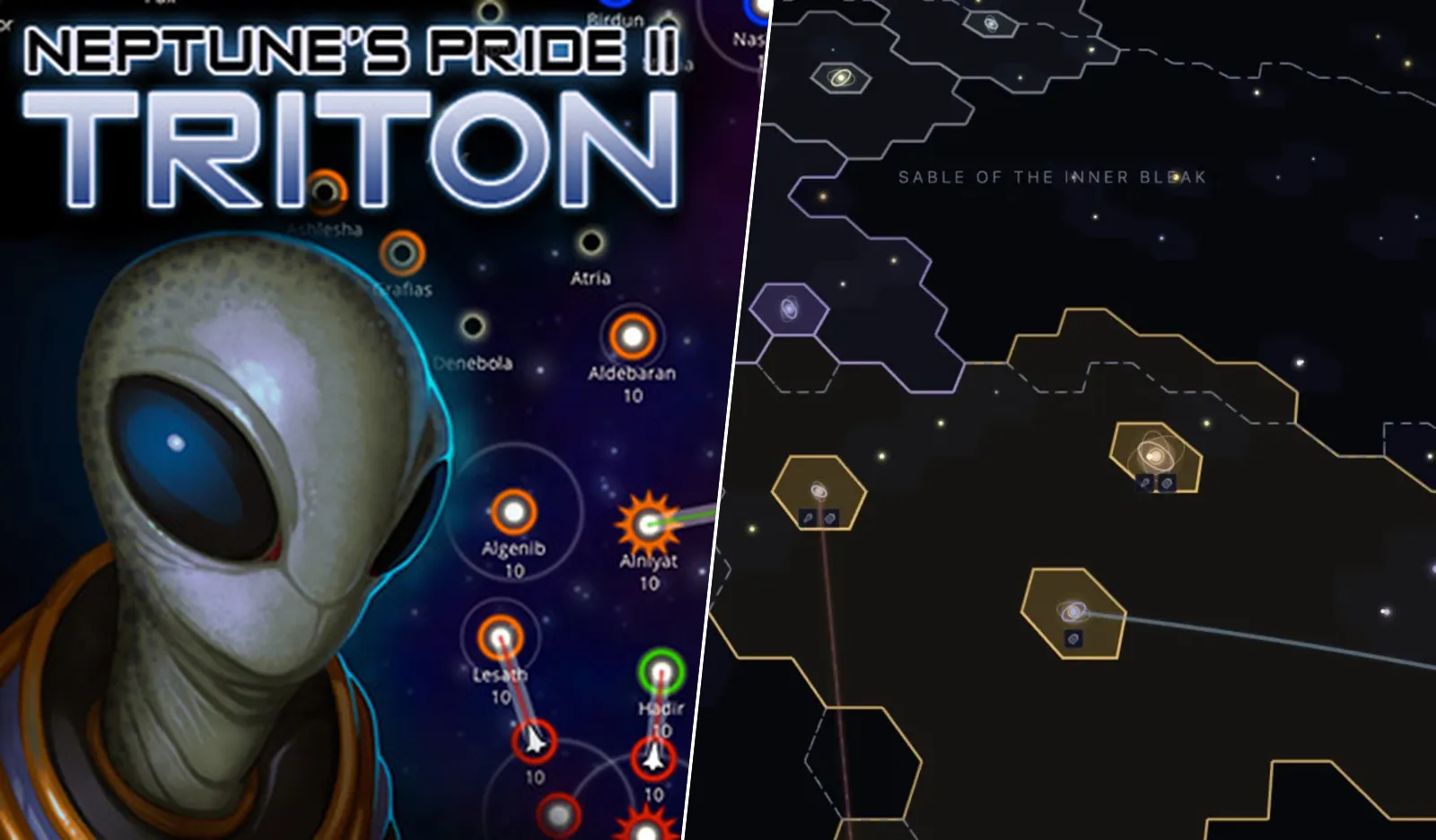
Neptune's Pride is the game people describe with a story about an alarm clock. A rival fleet is due to land at 3 a.m., and the only way to answer it is to be awake when it does. That slow, real-time tension is the reason it is still talked about years after release, and it is also why players go looking for an alternative that fits a little better around the rest of their week.
What are the best games like Neptune's Pride?#
Search for slow real-time space strategy, where ships travel between stars on a real clock and the game keeps running while you are logged off. Solaris is the closest match and is open source. Subterfuge brings the same tension to phones in shorter matches, and Planets.nu plays out a similar empire in turns. Old Light runs on a real-time clock in a galaxy that never ends.
What Neptune's Pride gets right#
Neptune's Pride comes from Iron Helmet Games, released in 2010 and designed by Jay Kyburz. It runs in a browser and calls itself a slow real-time strategy game, and a second edition, Neptune's Pride 2: Triton, followed in 2013. A handful of players each start with a few stars, spend cash on economy, industry and science at those stars, and send carriers of ships to take more. The first player to hold a set share of the galaxy wins.
A tick passes every real hour, production pays out once a day, and a trip to a neighbouring star can take most of that day. Nobody can act faster than the galaxy allows, so a match is won by planning ahead and by talking to people. Alliances and betrayals carry most of a match, and one match can last a month or more. It won PC Gamer's web game of the year in 2010 and an honourable mention at the IGF, and players still trade stories about the friendships it strained.
Where it gets hard to fit in#
The same clock that makes Neptune's Pride tense also sets the schedule. A war is decided by whoever is awake when the fleets arrive, which is where the 3 a.m. alarms come from. Matches have a fixed end, so the galaxy you built is gone when someone wins and the next game starts from four stars again.
Solaris#
Solaris is a free, open-source browser game built closely on Neptune's Pride, which its developer lists as a main inspiration. It also has a Steam release. The core loop will feel familiar, with the same investments at each star and carriers moving in real time. A game usually runs two to three weeks and can hold up to 64 players. On top of that Solaris adds specialists and trading, and its maps have nebulae that hide ships passing through them.
Subterfuge#
Subterfuge is a slow real-time strategy game for iOS and Android, set under the sea instead of in space. Matches run in real time over roughly a week to ten days with up to ten players. Its best-known feature is a time machine that lets you schedule orders ahead and preview where the map is heading, which takes some of the edge off needing to be online at the exact moment. Free players can queue a limited number of moves ahead and paying players get more. It is iOS and Android only, so it does not suit a desktop browser.
Planets.nu#
Planets.nu is the browser home of VGA Planets, a space empire game that dates back to the 1990s. It is free and also on Steam. Unlike the other games here, Planets.nu is turn-based. Every player submits orders and the turn resolves for everyone at once, so nobody needs to be awake at a set hour. It also goes deeper than Neptune's Pride on ship design, with twelve races to choose from.
Where Old Light fits#
Old Light is a free slow real-time strategy game that runs in a browser, with nothing to install. Its galaxy is persistent, so your empire is still there next month and new players arrive into the same map rather than a fresh match. Structures take minutes to hours to build and fleets travel between stars on real timers, while resources keep accruing with the tab shut.
You can see every empire's borders across the whole galaxy, but what a rival has built stays hidden until you scout it with a probe. Players talk in private conversations and can sign peace treaties that hold for a fixed term, and the thinking behind them is in peace treaties in a browser strategy game. New empires start behind a five-day beginner shield, and morale makes it costly for a much larger empire to pick on a small one, so falling behind early does not end your game. There is no pay-for-power: the optional Premium buys bigger queues and cosmetics, never stronger fleets.
Old Light does not have Neptune's Pride's sharp finish. There is no race to a share of the stars and no winner announced at the end of a month, and its player base is still small.
How they compare#
| Feature | Neptune's Pride | Solaris | Subterfuge | Planets.nu | Old Light |
|---|---|---|---|---|---|
| Clock | Slow real time | Slow real time | Slow real time | Turns | Slow real time |
| Game length | Fixed match | Fixed match | Fixed match | Separate games | Persistent |
| Plays in a browser | Yes | Yes | No | Yes | Yes |
| Free to play | Yes, with extras | Yes | Yes, with extras | Yes | Yes |
Which one to pick#
Solaris is the pick for the classic experience with more players in each game. Phone players who like scheduling moves ahead should try Subterfuge, and anyone who could do without the real-time clock will find the same kind of empire in turns on Planets.nu. If you liked the clock and wanted to keep your empire after the match, Old Light is the closest fit. For more in this vein, see games like Astro Empires and Anacreon and games like Hades' Star. There is also a list of free space strategy games.
Common questions#
Does Neptune's Pride run in a browser?#
Yes. Iron Helmet built it as a browser game, and its site still lists it. If you want something in the same style that is actively developed, Solaris is open source and also released on Steam.
Is there a free game like Neptune's Pride?#
Yes. Solaris and Planets.nu are both free, and Old Light is free to play with nothing on sale that makes an empire stronger.
Is there a game like Neptune's Pride that doesn't end?#
Most games in this style are fixed matches that end when one player wins. Old Light runs in a persistent galaxy instead, so an empire keeps growing from one session to the next. The difference between a match and a world comes up again in games like Tribal Wars, set in space.
How much time does a slow real-time strategy game take?#
A few short check-ins a day is usual, since builds and travel take hours. Old Light is designed around checking in twice a day. Missing one hurts most in a fixed match close to its end. In a persistent game with protection for smaller empires, a missed day costs you less. The how to play guide shows what a first day in Old Light looks like.
