
Essay
How combat works in Old Light: rounds, rolls and odds
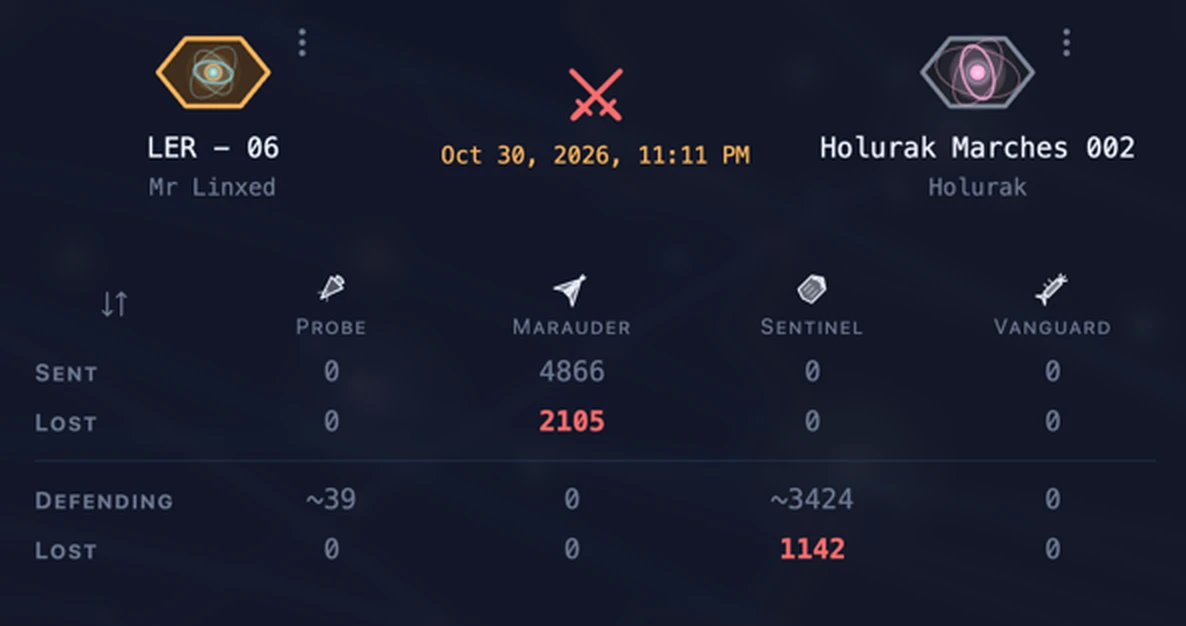
The combat guide in Old Light describes what tends to happen in a battle. Below are the rules that decide it, exactly as the server runs them, with the numbers worked through.
Is combat turn-based?#
Nobody gives orders during a battle. When a fleet carrying Marauders or Sentinels lands on a system held by another empire, the server resolves the whole fight on arrival and both sides get a report. Your decisions all come before that, in what you send and when it lands. Old Light auto-resolves every fight, for reasons I went into in a post on Gratuitous Space Battles.
Inside that instant the fight runs in rounds: one, or two at most.
Offense and defense#
Every ship has an offense stat and a defense stat. They are the same numbers the guide pages show for each ship:
| Ship | Offense | Defense |
|---|---|---|
| Marauder | 7 | 3 |
| Sentinel | 2 | 13 |
| Probe | 0 | 1 |
The side decides which number a ship uses. An attacking ship always uses its offense, whether it is shooting or being shot at. A defending ship always uses its defense, for its own shots too.
That is why a Sentinel is a good defender and a poor attacker: parked at home it fights with 13, but sent at another empire's system it fights with 2.
How attack rolls work#
Each shot first rolls to hit, with a 95% chance. A miss does nothing. If it hits, a second roll decides whether the target dies:
kill chance = shooter's number / (shooter's number + target's number)
There is no damage and no hit points, so a ship that loses the kill roll is destroyed outright.
Some single shots, with both rolls combined:
| Shot | Kill chance |
|---|---|
| Attacking Marauder at a defending Sentinel | 95% × 7/20 = 33% |
| Defending Sentinel at an attacking Marauder | 95% × 13/20 = 62% |
| Attacking Marauder at a defending Marauder | 95% × 7/10 = 67% |
| Defending Marauder at an attacking Marauder | 95% × 3/10 = 29% |
| Attacking Sentinel at a defending Marauder | 95% × 2/5 = 38% |
A Marauder attacking a Sentinel needs about three shots for every kill, while the Sentinel answers with better than even odds each time.
Who shoots at whom#
Each round, the two fleets are split into small groups, and every shot happens inside a group. How the groups form depends on which side is bigger.
When the attacker has more ships, each defending ship gets its own group of attackers. 250 attackers against 100 defenders of one type makes 50 groups of three attackers and 50 groups of two. Every attacker in a group shoots at that one defender, and once a shot kills it the rest of the group holds fire. The defender then fires one shot back at a random attacker in its group.
When the defender has more ships, each attacker gets its own group of defenders. 50 attackers against 150 defenders makes groups of three. The attacker fires one shot into its group, and the defenders in the group fire back at it until one of them kills it.
Attackers fire first within each group, but a ship killed during a round still fires its own shot that round, because losses are removed only once the round is over.
Attackers aim at the toughest ships#
When a garrison mixes ship types, attackers concentrate on high-defense targets. When the attacker is the bigger side, each defender's share of attackers is proportional to its defense, so a Sentinel at 13 draws thirteen times the fire of a Probe at 1. When the defender is the bigger side, the groups themselves form at random, and each attacker picks its target within its group the same way.
In a garrison of one ship type everyone counts the same, and the groups come out even.
The second round and the round limit#
After round one, the battle ends unless both of these hold:
- Both sides still have at least one ship.
- One side started the battle with more than 2.2 times as many ships as the other.
The ratio uses the ship counts from the start of the battle, not what survived round one. Those are the numbers you can see and plan around before you send a fleet. A garrison 2.2 times the size of the incoming fleet earns a second round too.
Round two plays out like round one, with the survivors, and the side that earned it fights with a small edge. If the attacker earned it, its offense goes up by 1 and the defender's defense goes down by 1. If the defender earned it, the defender's defense goes up by 1 and the attacker's offense goes down by 1. A Marauder attacking a Sentinel in an attacker-earned round two kills with 95% × 8/20 = 38% per shot instead of 33%, and the Sentinel's reply drops from 62% to 57%.
A side in credit deficit never earns round two, even when its numbers clear the ratio.
What sits out#
Probes on the attacking side never join the main battle. They come home whatever happens to the escort. Vanguards sit out as well, and a fleet with no Marauders or Sentinels skips the main battle entirely. Probes on the defending side do stay in the fight, but with defense 1 they draw little of the attacker's fire when the attacker has the bigger fleet, and their own shots rarely kill anything.
Strength modifiers#
A side's strength scales both its chance to hit and the number it plugs into the kill formula.
A credit deficit cuts a side to 40% strength. Its hit chance falls from 95% to 38%, and its number in the kill formula is multiplied by 0.4. An attacking Marauder in deficit kills a Sentinel with about 7% of its shots instead of 33%.
Morale lowers the attacker's strength when a much larger empire attacks a much smaller one, and it multiplies with a deficit. A sector defense bonus raises a defender's strength by up to 20%. Boosts raise the hit chance too, capped at certainty, along with the number in the kill formula.
Worked examples#
Ten Marauders against one Sentinel. All ten shoot at the Sentinel, each with a 33% kill chance. The Sentinel survives all ten only 1.8% of the time. Dead or not, it fires once, and that shot kills a Marauder 62% of the time.
Fifty Marauders against 150 Sentinels. Each Marauder faces a group of three. It fires one shot at 33%, then takes three shots at 62% each, and it survives those only about 6% of the time. The defenders started with three times as many ships, so they also earn a second round, with defense 14 against offense 6. Over thousands of simulated battles the attacker loses the whole fleet and takes about 17 Sentinels down with it.
Marauders against 100 Sentinels. The same garrison against fleets of different sizes, averaged over 5,000 simulated battles each:
| Attacking Marauders | Rounds | Marauders lost | Sentinels lost | Garrison wiped out |
|---|---|---|---|---|
| 100 | 1 | 62 | 33 | never |
| 200 | 1 | 62 | 56 | never |
| 250 | 2 | 83 | 97 | 6% of battles |
| 300 | 2 | 79 | 99 | about half |
| 400 | 2 | 73 | 100 | 98% of battles |
The attacker's losses hold at 62 from 100 to 200 Marauders. Every Sentinel fires once in round one whether it dies or not, so 100 Sentinels at 62% each kill about 62 Marauders however many arrive. Going to 250 earns round two, which costs the attacker more ships and leaves the garrison almost gone. From there a bigger fleet loses fewer ships, because more Sentinels die in round one and fewer are left to fire in round two.
The same 250 Marauders sent from an empire in credit deficit fight one round at 40% strength. They lose about 78 ships and kill about 16 Sentinels.