
Essay
How empire borders and territory work in a shared galaxy
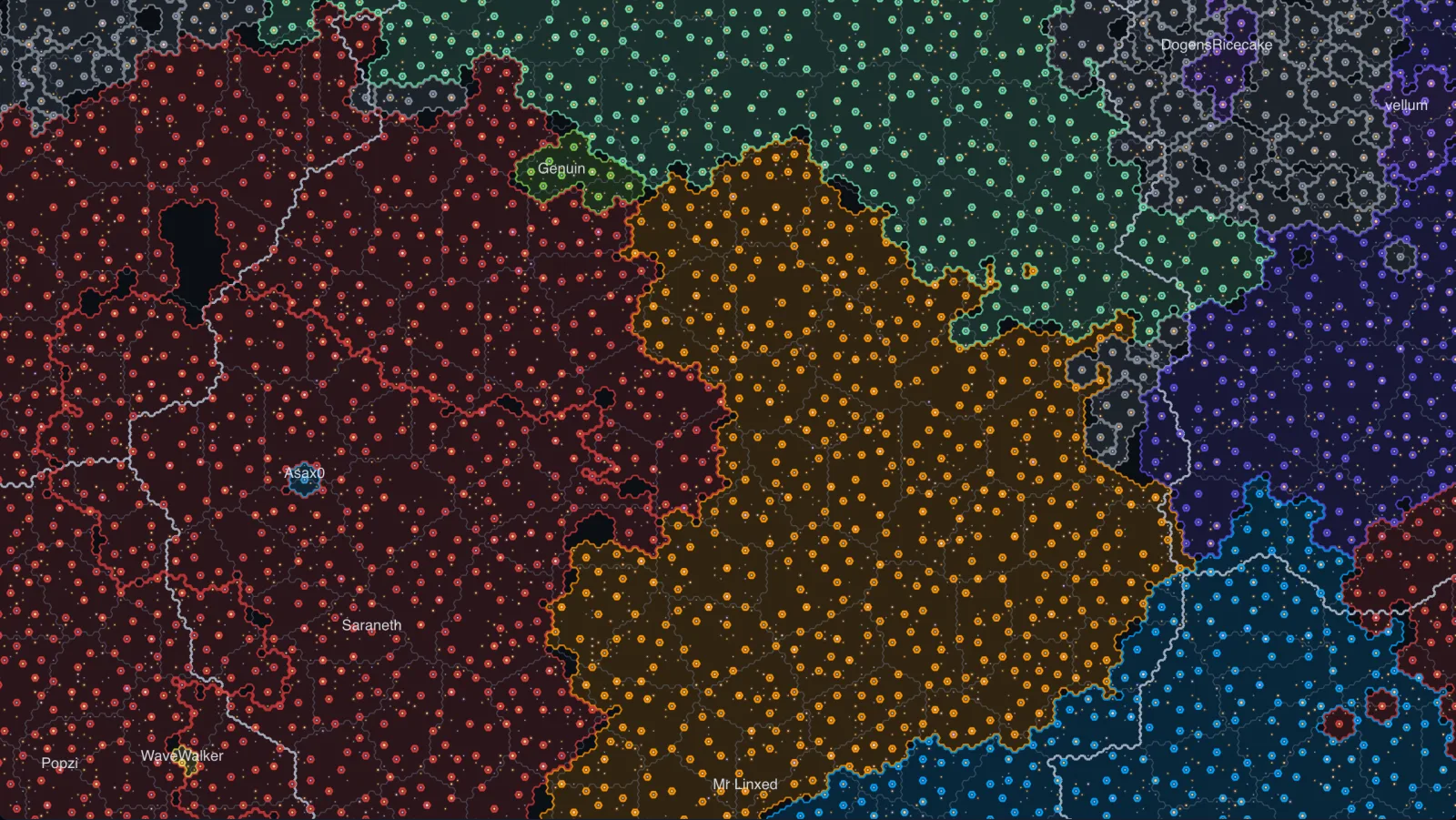
Every star system you own in Old Light claims the hexes within two of it. Those hexes are your territory, and they fill with your banner colour on the map. Where two empires reach for the same hex, the empire that claimed its system first keeps it. The rule fits in two lines of the borders guide, and most of what makes territory interesting comes from how it plays out with a few hundred empires in one galaxy.
Territory doesn't stop fleets#
Rival ships can fly across your territory and raid a dormant star sitting inside it. When that happens, you get a report naming the empire and the hex, though not what they took or where they flew in from.
Borders that blocked movement would let a large empire seal off a whole part of the galaxy, and with everyone on one map, the players around it would have nowhere to go. As it is, the space stays open, and the empire holding it gets told when someone acts there.
How far a system's territory reaches#
Two numbers decide the shape of an empire. Each system projects two hexes outward, and a new system of yours must sit at least three hexes from every system you already hold.
Because of the spacing, your systems can never sit right next to each other. Two of them up to five hexes apart still give one unbroken border along the line between them, and at six apart a gap opens. A well-placed empire ends up as a spread of systems at roughly even distances, each one covering the gaps around its neighbours.
The spacing matters most for the sector bonus. A sector's bonus goes to the single empire whose territory covers at least 60% of it, and coverage is counted in hexes of territory rather than systems owned. A few systems bunched in one corner of a sector can lose it to fewer systems spread across it.
Where territories overlap, the older claim wins#
Each disputed hex goes to whichever empire claimed its nearby system first. I wrote about the land rush this causes in an earlier post on emergent gameplay. An early, cheap system in a region you might want later boxes out everyone who arrives after you, and the border between two empires ends up recording who settled that ground first.
A captured system starts a new claim#
When you capture a system, its claim is stamped with the moment you took it. You don't inherit the age of the claim you replaced. A star its old owner settled in the first week becomes the youngest claim in its neighbourhood the moment it changes hands.
Every older claim around it keeps the hexes it already had, including the ones from the defender's other systems nearby. Your new star holds only what no older claim reaches. Take one system out of the middle of a rival's territory and you get a dot of your colour with very little around it.
The surrounding territory comes with the neighbouring systems, once you take those too. On the map, a conquest shows up as a slow push into a region, one system at a time. A defender who loses a star in the middle of their territory hasn't necessarily lost the sector bonus either, because their surrounding claims still cover most of it.
Once an attacker has taken enough to push a defender under 60% of a sector, the bonus goes at once. There is no grace period and no partial bonus, and the sector stays unheld until an empire reaches 60% again.
Painted pockets don't count toward sector control#
When an empire's territory surrounds a small pocket of empty hexes, the map paints the pocket in the empire's colour, as long as there is nothing in it the empire could ever settle. Without that, a tightly packed empire would be dotted with holes that mean nothing.
Sector control ignores those painted pockets. It is measured on real projection only: the hexes within two of a system you own, after the older-claim rule. The fill is only there to make the map easier to read.
Neighbouring empires also never share a border line on the map. Each border is pulled in slightly, leaving a thin gap, so two empires packed side by side still read as two. The gap exists only in the drawing, and the hexes on either side of it belong to whoever the older-claim rule gives them to.
Who can see your territory#
Every empire's territory is visible to everyone, across the whole galaxy, in the game and on the public galaxy map. You can always see who holds a region and how far they reach. What anyone has built inside it stays hidden until you send a probe, and so do their fleets.
A wide, lightly built empire and a narrow, heavily built one can have similar outlines, which is why scouting still matters next to a border you can already see. Sector bonuses follow territory, and regions rank empires by the sector bonuses they hold, so where you place your systems also decides where you stand on those rankings.
Common questions#
How far does an empire's territory reach in Old Light?#
Two hexes from every system the empire owns. The hexes in that range are its territory even with nothing built on them.
Who gets a hex when two empires' borders overlap?#
The empire whose nearby system was claimed first. A captured system counts as claimed at the moment of capture, so it is always the newest claim around it.
Can enemy fleets enter my territory?#
Yes. Territory doesn't block movement. If a rival raids a dormant star inside your territory, you get a report with their name and the location.
Does territory affect sector bonuses?#
Yes. A sector's bonus goes to the one empire whose territory covers at least 60% of that sector. Coverage is measured in hexes of territory, so systems spread across a sector cover more of it than the same number bunched together.
