
Essay
Emergent gameplay from plain rules
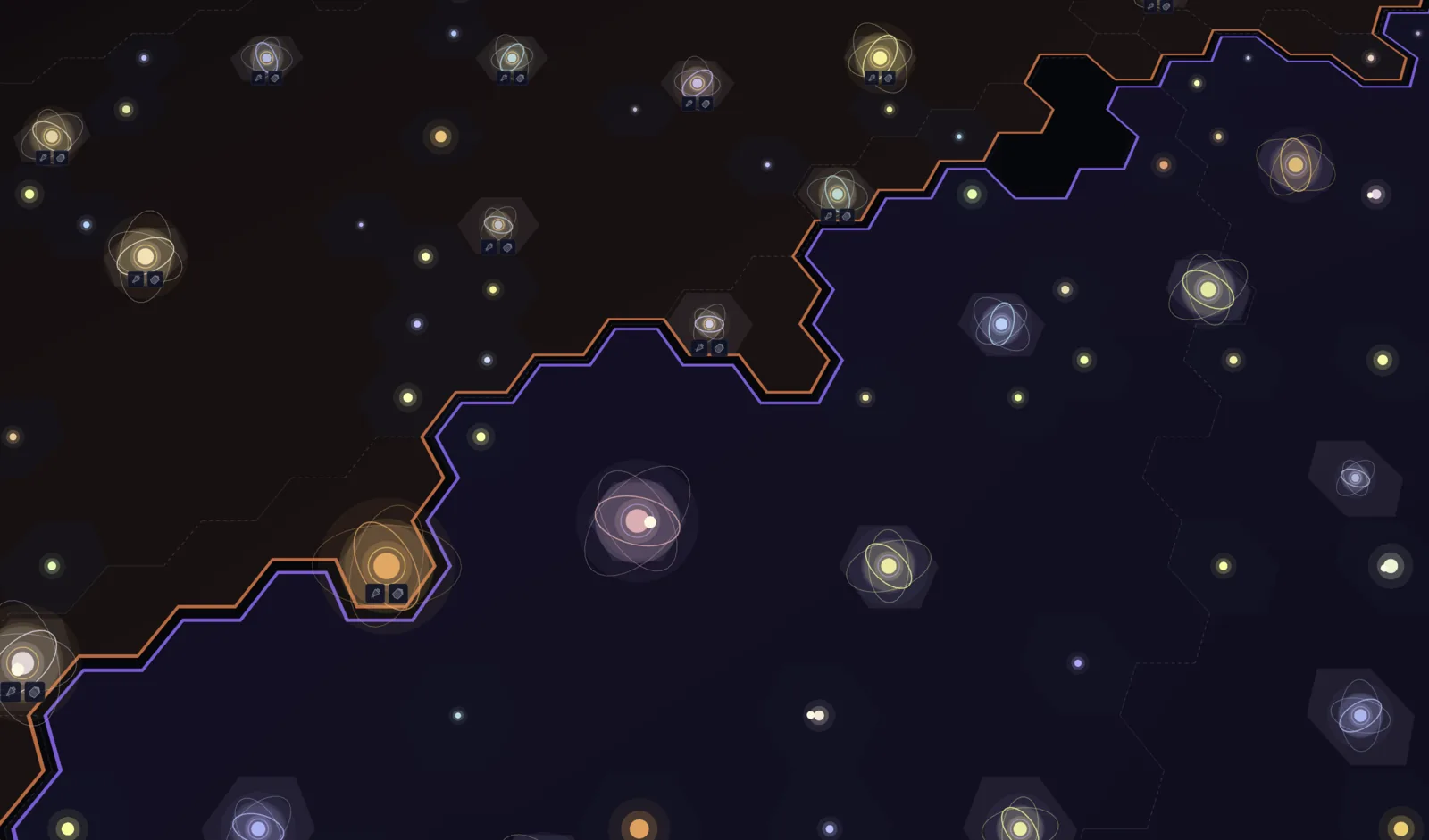
Emergent gameplay is when a game produces situations nobody scripted. A branching story does not qualify, because a writer prepared every branch. Emergence needs a small set of rules that collide and produce something the designer never typed in. Harvey Smith made the case for it in a 2001 talk that circulated widely among designers, with the examples people still quote: players stacking proximity mines to climb out of Deus Ex's intended boundaries, and cracking safes with the blast from a dying enemy. Most writing since has stayed at that altitude, without naming a rule in a running game and showing what came out of it.
This post is the concrete version, from a game I run in production. Old Light is a slow, real-time strategy game in a shared galaxy, and most of what players actually spend their time on comes out of a handful of rules I can each state in one sentence. Below are five examples, each with the rule first and then the part I care about: what players did with it.
The older claim wins the hex#
The rule: every system you occupy projects territory two hexes outward, and where two empires would overlap, the hex goes to whichever empire claimed its system first. How empire borders work covers the rule in more detail, including what happens to a claim when its system is captured.
That tiebreak is one line in the borders rules and one sort in the renderer. What falls out of it is a land rush. Being early in a region is permanently worth something, because the border you project today is the border every later arrival has to fit around. Players learn to plant a cheap system in a region they might want next month, not for what it produces but for the two-hex shadow it casts. A modest early claim boxes rivals out of space they would otherwise walk into.
The second effect I did not design for at all: borders became a historical record. Because every overlap resolves by capture time, the shape of the line between two empires encodes the order in which that part of the galaxy was settled. Look at a contested frontier and you can read who was there first, and roughly when each side pushed. The tiebreak was only ever meant to stop two empires claiming the same hex.
Overreach slows you down#
The rule: every structure in a system draws energy, the reactor sets the ceiling, and a system over its budget slows down until you fix it.
There is no hard failure state here. Resource production slows, and the deeper the deficit the worse it gets. Out of that soft penalty comes the overextension trap: the fastest-looking way to race a rival is to queue structures faster than you can power them, which is exactly the behaviour the penalty taxes. Racing at full tilt makes your empire produce less than a slower one.
The same rule produces comebacks. A leader who overbuilt is weaker than their map presence suggests, and because a deficit is always recoverable (upgrade the reactor, or downgrade something that draws energy), falling behind is a setback rather than a death spiral. I never wrote a catch-up mechanic for players who fall behind. The energy budget was already doing that work.
A broke empire fights badly#
The rule: every ship drains credits continuously, and an empire whose treasury has run dry fights at reduced effectiveness.
This is the rule that turned economics into a weapon. Ships in a credit deficit hit less hard and less often. And when a fight is lopsided enough that the bigger side would normally press a second wave to finish the job, a broke empire forfeits that wave entirely. Overwhelming force with an empty treasury wins the first exchange and then stops.
Which means a fleet can be beaten before it ever undocks. Watch a rival grow their navy past what their trade income supports and you know their clock is running. You can also push them onto that clock: an empire that feels threatened parks defenders everywhere, and every parked defender costs upkeep, so a neighbour who merely looks dangerous for a few weeks is draining someone's treasury. Nothing in the combat rules mentions siege by intimidation, but the upkeep rule makes it a real strategy.
Toughness draws the fire#
The rule: attackers concentrate their fire on the toughest defenders, so soft ships draw almost none of it.
An earlier version of the resolver spread fire evenly across whatever was parked in a system, and the math immediately favoured a degenerate defence: pad your garrison with cheap probes so they soak shots meant for your real warships. Sometimes what the rules reward is optimal and deeply boring, and a meat shield of recon ships was exactly that.
The fix was not a special case. No rule says probes may not absorb fire. Instead, targeting itself became a plausible behaviour: shoot the dangerous ships first. Once attackers prioritise by toughness, a probe screen survives the battle while protecting nothing, so the exploit stopped paying without ever being banned. When the balance simulator surfaces something degenerate now, I look for a change in the incentives like that one before I consider a special case.
The locals set the pace#
The rule: NPC empires pace themselves against the strongest human near them, and never run ahead unprompted.
NPC empires in Old Light play by the same rules humans do, with no hidden bonuses, and their ambition is deliberately local. They do not chase the galaxy's leader. They hover around whoever is strongest in their own neighbourhood, growing when that player grows and idling when nobody is around.
The result is that difficulty varies across the map without anyone tuning it. A beginner's corner stays survivable because nothing there has a reason to race. A strong player's neighbourhood stiffens on its own, because the NPC next door is keying off them specifically. The alternative would have been a hand-tuned difficulty curve per region, kept in sync with wherever players happened to settle.
None of this works if the rules hide#
A surprising outcome is only fun when the player can trace it back to a rule they knew. The same outcome from a rule they could not have known reads as a bug, or as the server cheating.
So every rule above is published, in plain language, in the player guide. The border tiebreak, the deficit behaviour, the local NPC pacing, the way attackers pick targets: all of it is stated where any player can read it before it costs them anything. Combat keeps some randomness, but the spread is bounded and the shape of an outcome is always explainable afterward. My working test: if a mechanic needs more than a paragraph of guide text to explain, I change the mechanic.
The emergence I did not plan for#
Some of these I predicted. The land rush I expected, since it is the obvious consequence of a first-come tiebreak. The probe screen I half expected, and the focus-fire rule exists because of it.
Borders as a readable settlement history caught me off guard entirely. So did economic siege, the idea that a fleet you never launch can bankrupt a neighbour through the garrisons it forces them to keep. The one that still surprises me most has no combat in it at all. Messaging does nothing except let two empires talk, and it has no mechanical effect on anything in the galaxy, yet the moment it shipped a polite note about a border could function as an ultimatum with a deadline attached.
