
Essay
Gratuitous Space Battles and the case for auto-resolve combat
In November 2009, a one-man British studio called Positech Games released a game whose title told you exactly what you were buying. Gratuitous Space Battles served up enormous fleet engagements with no fiction to justify them (the store page still promises "large, completely unjustified space battles between huge opposing space fleets") and built the whole thing on one rule that almost nothing else on the shelf would touch: once the fight started, you could not intervene.
Hardly anyone writes about it anymore. The game is still for sale on Steam sixteen years later, but much of what was written about it at the time now leads to dead links. That's a shame, because the idea it committed to didn't fade with the coverage. It's the same idea my own game's combat runs on, and it's worth a proper look.
What the game actually was#
Cliff Harris, Positech's founder and sole developer, cast you as an admiral instead of a pilot. You designed warships by fitting modules into hulls: weapons and shields, armour plate, engines, crew quarters, a reactor to power the lot. Hulls ran from fighters up to cruisers. Then you arranged your fleet on your side of the field, gave each ship its standing orders (hold this range, escort that cruiser), and pressed go. From that moment the battle played out entirely on its own. The store description says it without apology: "the player does not control individual ships at all during battle."
So the loop was design and deploy, then watch. When you lost, the game was asking you to work out why and head back to the drawing board. Your only lever on the outcome was everything you did before the first shot.
Harris was clear about where this came from. Asked about the hands-off design in a 2013 interview with Space Game Junkie, he said: "The idea of hands-off battles was basically a reaction to frustration with the actual reality of most big RTS battles, which is total chaos where you know you should be on top of it all, but especially as you get older, you realize you just can't be. I wanted to design a game that accepted, and even embraced that as a design concept."
Why that was radical in 2009#
Remember what the genre looked like then. Real-time strategy meant control, and control was the skill. The competitive scene measured players in actions per minute, and every RTS review docked points for units that didn't respond crisply to your clicks. Against that orthodoxy, a game that took your hands off the wheel entirely read as either a gimmick or a provocation.
The argument underneath it was that most of what passes for tactics in a large real-time battle is frantic housekeeping, and that if you delete the housekeeping, what remains is the actual strategy. Which ships did you bring, and what did you tell them to do when things went wrong? In Gratuitous Space Battles those questions had to carry the entire game, because there was nothing else.
The battles themselves became pure spectacle, which is the joke in the name. You'd earned the fireworks through homework, and now your only job was to watch them and take notes for the next attempt.
The quiet multiplayer trick#
The part that aged best was the challenge system. You could upload a fleet, complete with its ship designs and standing orders, to an online server, where other players downloaded it and threw their own fleets at it. The server tracked who beat whose challenge.
Nobody had to be online at the same time. Your fleet fought for you while you slept, exactly as well as you had prepared it to. In 2009 that was an oddity. Today it describes an entire genre: the auto battler wave of the late 2010s runs on the same skeleton of build, arrange, then watch.
The original got decent rather than ecstatic reviews (a 72 on Metacritic), a sequel arrived in 2015, and both are still purchasable. Modest numbers for a game that called a genre a decade early.
Old Light makes the same bet#
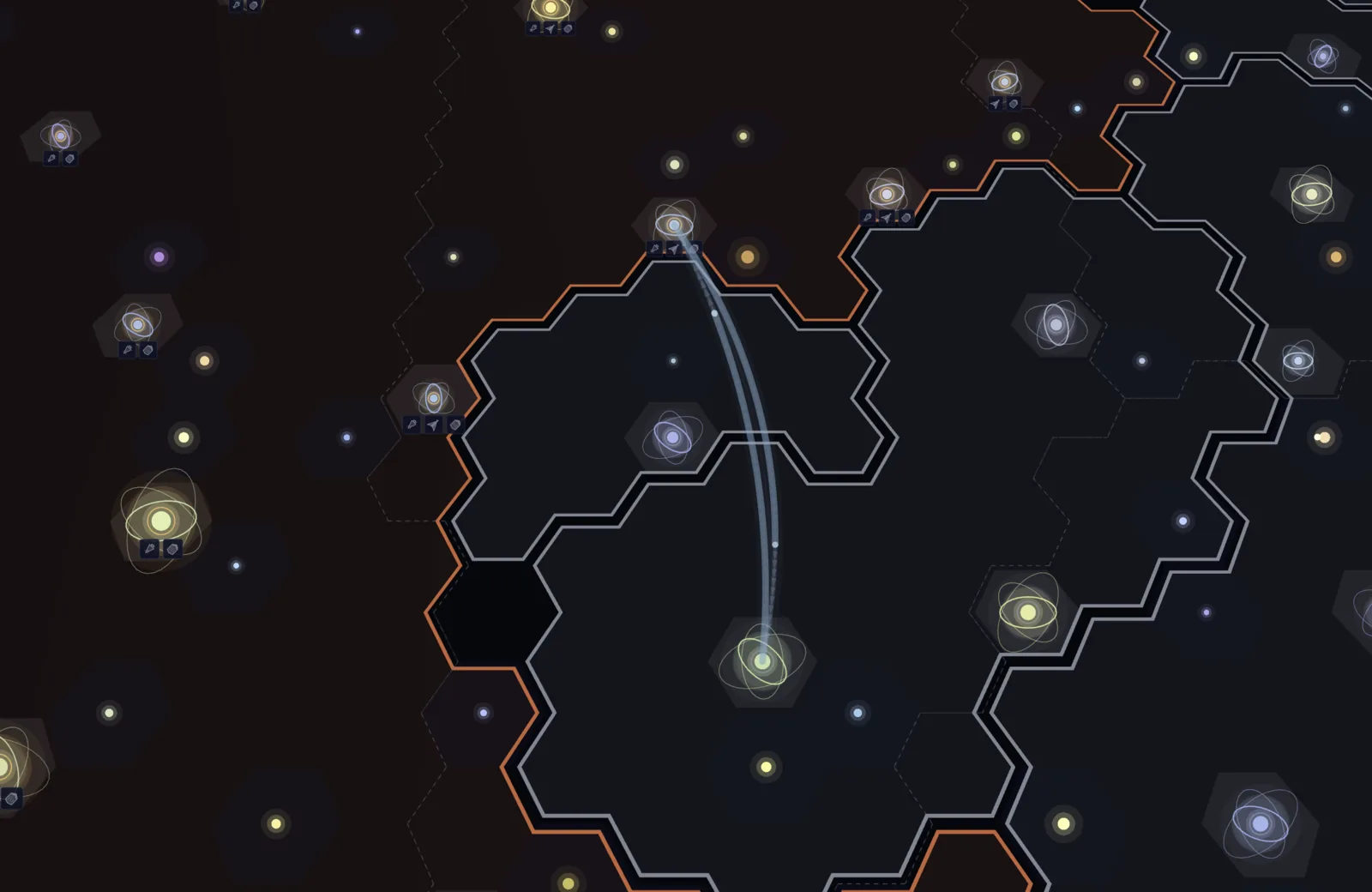
Old Light is a different animal: a slow, real-time strategy MMO where every player shares one persistent galaxy. But when your fleet arrives at a rival's system, the same rule applies. The server resolves the entire battle in one pass, and there is nothing to click while it happens. Not for you, and not for the defender.
The preparation looks different from GSB's. There's no ship designer; the roster is fixed, and each ship has a job. Marauders hit hard and bruise easily, which makes them attack ships. Sentinels are the reverse, so they stay home and hold ground. What you control is composition and timing, and above all what you know. Probes exist to fix that last part: a recon mission flies to a rival's system and files a report, and the more probes survive the trip, the more you learn about what's waiting. The defender, meanwhile, sees who sent the fleet, where it left from and when it lands, but never what is inside it, so their decision window is also preparation: reinforce, or accept the hit.
The spectacle, though, is gone. GSB replaced control with fireworks; Old Light replaces it with the report you open the morning after. Both sides get one. It tells you what you lost, and it fogs what your ships couldn't honestly have counted. Reading one after an overnight raid, working out where your assumptions failed, is the closest thing the game has to watching the lasers fly.
Why insist on this in an MMO? Fairness, mostly. In a persistent world, battles land at 4 a.m. your time, and any system that rewards being present mid-fight becomes a contest of alarm clocks, and then of scripts, because a bot will always out-click a human. Auto-resolve closes that door completely. The outcome flows from your composition and your intel, and neither depends on reflexes. It also happens to be the only way the server can stay sane: a battle that resolves as one pure function call works the same whether the galaxy sees ten fights a day or ten thousand.
What it costs#
The trade is not free. Auto-resolve deletes the clutch save: the wounded flagship yanked out of the fire at the last second, the comeback that was yours because your hands made it happen. Losing that costs the game something, and it is the objection I take most seriously.
In a single-player game you could hand the controls back and break nothing. In a shared persistent galaxy, it would cost everything the galaxy is built on, because the moment presence wins fights, absence loses them, and a game you check twice a day punishes you for having a life. I'd rather your defeats be something you can study than something you slept through. When a fight goes against you in Old Light, the report shows you a decision that was wrong: a garrison left too thin, or a fleet sent on stale intel.
Gratuitous Space Battles never became a household name. The bet it made is doing fine, though. Tonight, somewhere in Old Light's galaxy, a fleet will arrive at a rival system and fight a battle neither owner watches. Two reports in the morning will be all that's left of it.
