
Article
Persistent universe games that don't need 20 hours a week
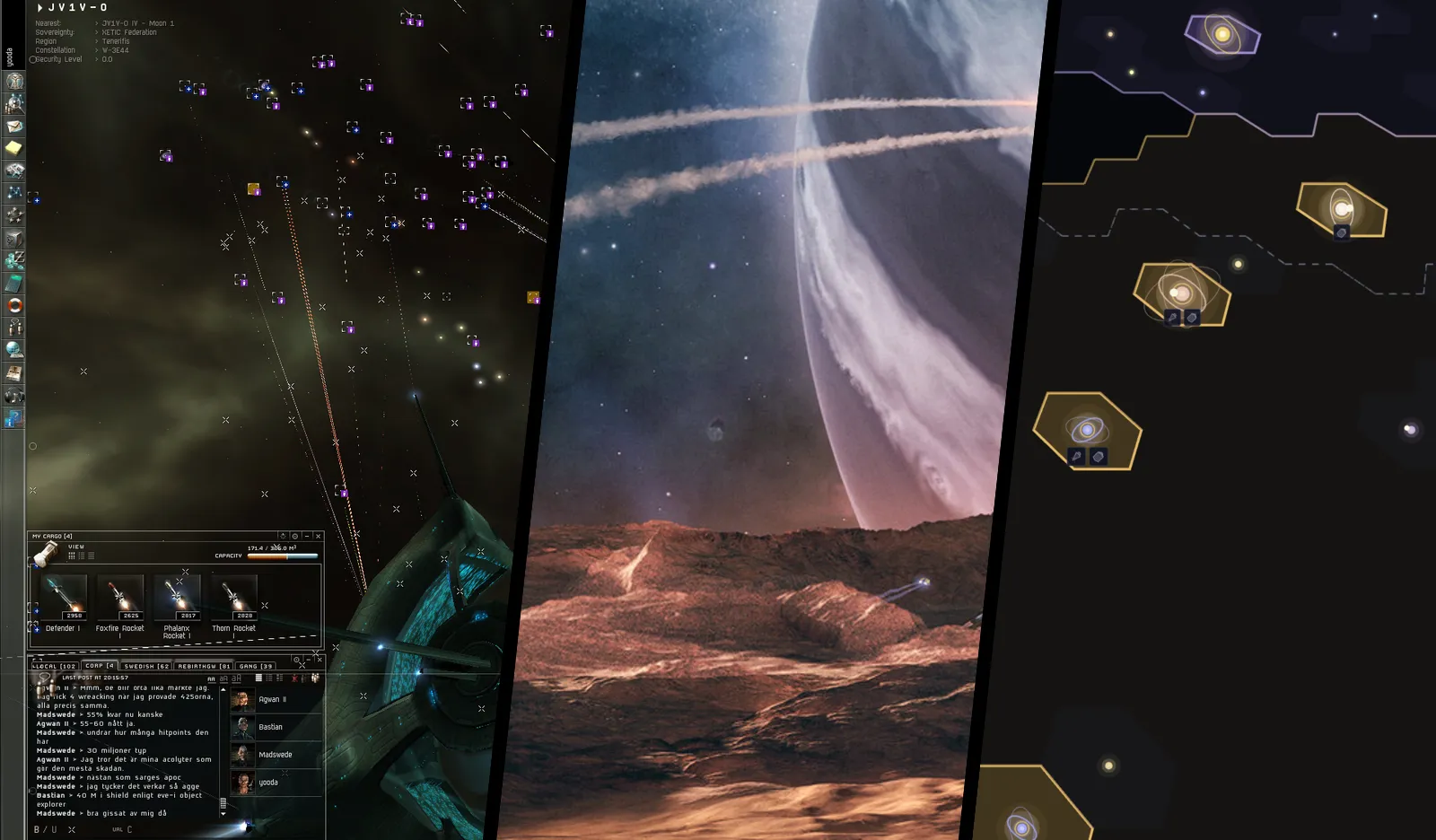
A persistent universe is a game world that keeps running when you log off. Fleets keep moving and economies keep turning, so the things other players did overnight are waiting for you in the morning. It is the pull behind the biggest space games, and a different feeling from a match that resets when you leave.
The catch is that the famous persistent universes were built for players with a lot of time. Falling behind is the price of logging off. This post splits the genre into the big ones that expect most of your week and the lighter lane that keeps the living-world feeling on a schedule a working adult can hold.
What makes a universe persistent#
Persistence is the promise that the world does not pause for you. In a shared persistent universe other real people are acting in the same space around the clock, so the map you come back to has changed while you were away. A foothold there feels earned, won against a galaxy that kept moving without you.
The trade is that persistence and presence usually get bundled together. A world that keeps moving tends to reward whoever moves in it most, which is how these games turn into second jobs.
What the big ones cost you#
EVE Online is the deepest of them and the most demanding. Real-time piloting, a player-run economy, permanent loss when your ship dies, and a competitive level that players put near twenty hours a week. It is extraordinary, and most people who try it do not last a month. If EVE specifically is what pulled you in, there is a companion piece on games like EVE Online without the twenty-hour weeks.
Elite Dangerous puts you in a cockpit in a full-scale Milky Way. The flight is the draw and it is superb, but progress in ships and engineering is a long grind, and it is a download and a commitment rather than something you dip into for a few minutes.
Star Citizen is the most ambitious and the least finished, a persistent universe still in development after years, with a reputation for both its scope and for asking a lot in money and patience. Worth watching, though not something to rely on as a settled game yet.
Dual Universe is the builder's take, a single-shard universe where players construct ships and structures from voxels. It is a smaller community now, and the construction depth is the draw as well as a heavy time investment.
The lighter lane#
These persistent universe games keep the shared-world feeling and drop the demand to be present for it.
Astro Empires is a real-time space 4X that has run for around twenty years, where empires grow over days across a shared galaxy and a few minutes a day keeps you in the game. It has a paid tier that lifts caps and adds scanners, covered in games like Astro Empires and Anacreon.
Anacreon is the cult classic, a browser rebuild of a 1987 strategy game with fleets that move while you are away. It is a long-quiet beta with a small crowd, worth it for the history, and it sits in the same games like Astro Empires and Anacreon piece.
Hades' Star is the phone-friendly pick, slower space strategy in a shared galaxy with a store that matters more the deeper you go. There is more in games like Hades' Star.
OGame is the fast, login-hungry granddaddy of browser space strategy, useful mostly as a reference point and covered in games like OGame and Travian.
Where Old Light fits#
Old Light is a newer entry built specifically for the lighter lane. One shared galaxy, nothing to download, and it keeps building while the tab is closed, so the world stays persistent without asking you to sit in it. You grow a home system, project borders across the map, scout rivals with probes, and send fleets to defend or take ground, mostly in two short checks a day.
Nothing sits behind a subscription and no payment buys a bigger empire, so there is no pay-for-power and a fight is decided by numbers and position. The honest cost of being young is a smaller galaxy than the veterans above and a pace that will feel slow next to a cockpit sim. If that suits you, the beginner's guide walks through your first days.
How they compare#
| Game | Runs in a browser | Minutes a day | No pay-for-power |
|---|---|---|---|
| EVE Online | No | No | No |
| Elite Dangerous | No | No | Yes |
| Star Citizen | No | No | No |
| Astro Empires | Yes | Yes | No |
| Old Light | Yes | Yes | Yes |
Which one to pick#
If you have the hours and want the deepest world, EVE Online has no real equal. If flying itself is the point, Elite Dangerous is the one to fly. Both ask for real time, so go in expecting that.
If you want the persistent-galaxy feeling on a working schedule, start with Astro Empires for an established game, or Old Light for a newer one on a level field built around short sessions. For the broader map of the genre there is a ranking of the best browser strategy games of 2026 and a roundup of free space strategy games.
Common questions#
What is a persistent universe game?#
A persistent universe is a game world that keeps running while you are logged off. Other players act in the same shared space around the clock, so the map keeps changing whether or not you are online.
Are there persistent universe games you can play in a browser?#
Yes. Astro Empires and Old Light are persistent, shared-galaxy games that run in a browser with nothing to download, unlike EVE Online, Elite Dangerous or Star Citizen.
Which persistent universe game needs the least time?#
The browser ones ask the least. Old Light is built around two short checks a day, and Astro Empires stays playable in a few minutes, where the big sandbox titles expect many hours a week.
Is Old Light free to play?#
Yes, with nothing for sale that makes your empire stronger, so there is no pay-for-power.
